
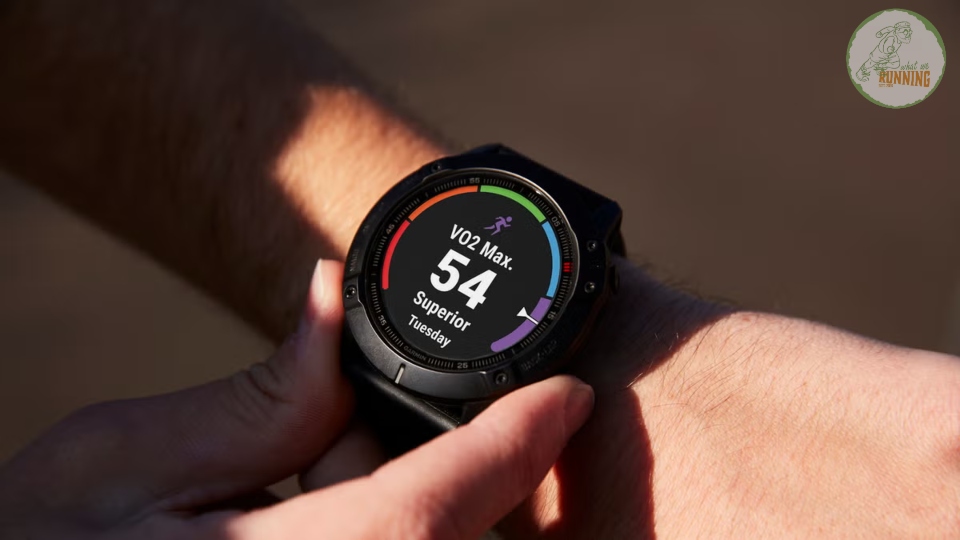
You look down at your watch, and it says your VO2 max is 45.
Is that any good?
Does it mean you’re fit? And, more importantly, does it mean you’re primed to race a fast 5k?
VO2 max is one of those numbers that runners hear about all the time. It’s displayed on Garmin watches, Apple Watch, and just about any other fitness tracker, shows up in training plans and gets tossed about whenever anyone talks about aerobic fitness. But unless you’re especially interested in exercise physiology, chances are you don’t actually know what your VO2 max means – or how much attention you should be giving it.
So, what is VO2 max for runners, and why does it matter?
Today at What We Running, we’re breaking down precisely what VO2 max actually measures, what counts as a good VO2 max, how it ties to running performance, and whether it can predict your 5k time. We’ll also explore how accurate watch estimates really are, and what you can do to improve your VO2 max through running.
What Is VO2 Max?
VO2 max is the maximum amount of oxygen your body can use during intense exercise. It is one measure of aerobic fitness and is typically expressed as millilitres of oxygen used per kilogram of body weight per minute (ml/kg/min).
In layman’s terms, your VO2 max tells you how effective your body is in taking in oxygen and using it to produce energy when you’re working hard.
When you run, your lungs take oxygen from the air, and your heart pumps oxygen-rich blood around your body. Your muscles then use that oxygen to help produce the energy needed to keep you moving. The harder you run, the more oxygen your body requires. Eventually, you come to the point where your body can’t use any more, even if you’re continuing to push harder.
That point is your VO2 max.
For runners, it’s essentially a measurement of your maximum aerobic capacity. A higher VO2 max typically means your body has a bigger capacity to use oxygen during exercise – crucially, though, it doesn’t automatically mean you’re a quicker runner.
What Does the “VO2” Part Mean?
The “V” refers to volume, while “O2” refers to oxygen. Put together, VO2 describes the amount of oxygen your body is consuming.
What Does the “Max” Part Mean?
The “max” just means maximum.
Your VO2 max is therefore asking one basic question: how much oxygen can your body use when you’re pushing yourself to the max?
For runners, it’s one handy part of the fitness puzzle – but certainly not the complete picture.

Why Does VO2 Max Matter For Runners?
If you’re a runner, your body demands a steady supply of oxygen to help produce the energy needed to keep you going. The more effectively your body can take in, transport and use oxygen, the greater your aerobic capacity.
That’s where VO2 max really matters.
A higher VO2 max usually means your body has a greater capacity to use oxygen during intense workouts. In theory, that lends you a bigger aerobic engine to work with – something that can be especially handy when you’re racing or running at a sustained hard effort.
But there’s an important distinction to keep in mind:
VO2 max isn’t the same thing as running ability.
Your performance also depends on factors like running economy, which is how efficiently you use energy while running and lactate threshold, which influences how hard you can run before fatigue starts to rapidly take hold.
Then there’s endurance, training experience, pacing, and your ability to maintain an effort over a distance.
That’s why two runners with the exact same VO2 max can still have radically different race times. VO2 max tells you something useful about your aerobic capacity, but not the full, complete picture.
Think of it as the size of your aerobic engine – not necessarily how well you can drive the car.
What Is A Good VO2 Max For A Runner?
There isn’t a universal VO2 max number that makes someone a “good” runner. What’s considered a good VO2 max hinges on several factors, including your age, sex, training history, and how your VO2 max was measured.
That said, having a rough benchmark can help put your own number into perspective.
VO2 Max Ranges for Runners
As a broad guide, you may interpret VO2 max values like this:
| VO2 Max | Rough interpretation |
| Under 30 | Lower aerobic fitness |
| 30-40 | Recreational fitness |
| 40-50 | Good aerobic fitness |
| 50-60 | Very good aerobic fitness |
| 60+ | Excellent/high-level aerobic fitness |
These ranges are illustrative, not universal standards. A VO2 max of 47 may be excellent for one person, and relatively normal for someone else, depending on their age and circumstances. It’s also worth keeping in mind that a number estimated by a running watch isn’t necessarily comparable with a laboratory measurement.
What Is a Good VO2 Max for a 5k Runner?
If 5ks are your benchmark, don’t fall into the trap of believing you need an exceptionally high VO2 max to be a good runner.
A VO2 max in the 40s can represent solid aerobic fitness, especially for a casual runner. And while elite distance runners usually have VO2 max values much higher than this, you don’t need an elite physiology to run a fast or enjoyable 5k.
Your VO2 max is just one part of the equation. Running economy, lactate threshold, endurance and training consistency can all play a major role in how quickly you’re able to actually run.
So, instead of asking whether your number is “good”, it can be more helpful to ask whether your aerobic fitness is improving over time.
VO2 Max By Age – Does Your Number Change As You Get Older?
Short answer: yes. VO2 max generally declines with age, even in people who remain active. This is partly due to changes in cardiovascular capacity and muscle function as we get older.
However, this doesn’t mean your VO2 max is destined to drop like a stone. Regular exercise, especially consistent aerobic training, can help maintain a higher level of aerobic fitness and influence how quickly your VO2 max declines.
That’s why comparing your number with someone far younger than you isn’t particularly helpful. A better question is whether your VO2 max is healthy and appropriate for your age and training background.
As a very broad guide:
| Age | What to consider |
| 20-29 | Typically higher aerobic capacity |
| 30-39 | Gradual decline may appear |
| 40-49 | Decline can become more noticeable |
| 50-59 | Regular training remains highly influential |
| 60+ | Individual variation becomes increasingly important |
There is no single “good VO2 max by age” number that applies to everyone. Your training history, genetics, body composition, and how the measurement was taken can all affect the result.
For runners, tracking your own progress over time is usually more useful than obsessing over how your number stacks up against someone else.
Does VO2 Max Predict Your 5k Time?
Kind of – but not perfectly.
VO2 max is linked to endurance performance, so it can give you something of an indication about your potential as a 5k runner. Generally speaking, a higher aerobic capacity gives you a bigger engine to work with.
But your VO2 max can’t tell you precisely how fast you’ll run.
Two runners can have an identical VO2 max and still finish a 5k several minutes apart. That’s because your race performance depends on so much more than just how much oxygen your body can use.
VO2 Max Isn’t the Complete Story
Take two hypothetical runners:
Runner A: VO2 max of 50
Runner B: VO2 max of 50
On paper, their aerobic capacity is the same. But Runner B may still beat Runner A because they have better running economy or a higher lactate threshold.
Other factors matter too. Training experience, pacing, fatigue resistance, and strength can all influence how effectively you turn your aerobic capacity into running performance. Even race-day conditions, such as heat, wind and hills, can all make a dramatic difference.
There’s also the mental side of running to consider. Your ability to tolerate discomfort and maintain your pace when the final kilometre starts to hurt matters too.
So while VO2 max can provide a handy indication of your aerobic fitness, don’t treat it as a 5k time predictor. Your VO2 max tells you about the size of the engine; your training determines how effectively you use it.
Why Is My VO2 Max Different On My Garmin Or Apple Watch?
If your Garmin or Apple Watch gives you a VO2 max score, it’s important to understand that your watch is estimating your VO2 max rather than directly measuring it.
A laboratory VO2 max test involves exercising while wearing equipment that measures the oxygen you breathe in and out. On the other hand, your watch uses data collected during normal workouts to produce its estimate.
How Do Running Watches Estimate VO2 Max?
Different devices use different algorithms, but typically they look at the relationship between how hard your body is working and the performance you’re producing.
Garmin, for example, analyses the relationship between your running pace and how hard your body is working, using performance data collected during your session. Apple Watch uses its heart and motion sensors during eligible outdoor walking, running, and hiking workouts, while also taking information such as your age, sex, weight and height into account.
How Accurate Is Watch VO2 Max?
Your watch’s estimate can be useful for tracking trends in your fitness, but it shouldn’t be treated as identical to a laboratory measurement.
The most useful question isn’t necessarily whether your watch has calculated your precise VO2 max. It’s whether the number is consistently moving in the right direction over time.
Your watch’s VO2 max is an estimate, not a diagnosis of your fitness.
Why Has My VO2 Max Gone Down?
Don’t panic if you see your number suddenly dropping.
Heat, hills, fatigue, illness, poor sleep, inaccurate heart rate data, GPS issues, and just running slower than usual can all affect the data your watch uses to estimate your fitness. Garmin specifically notes that environmental conditions like heat, humidity, and altitude can all affect performance data.
A one-point drop after a tricky run doesn’t necessarily mean you’ve suddenly become less fit. Look at the trend over weeks and months rather than judging your fitness from one reading.
Can You Improve Your VO2 Max Through Running?
Yes. Your VO2 max isn’t necessarily a fixed number. Consistent aerobic training can improve your body’s ability to take in, transport and use oxygen, especially when your training plan includes workouts that challenge your cardiovascular system.
You don’t need to spend every run gasping for air, either. In fact, a balanced training program is likely to be more useful than constantly trying to run at a maximum effort.
The Best Running Workouts for Improving VO2 Max
Interval training is one of the best ways to target your VO2 max. This could include shorter, hard repetitions or longer intervals performed at a tougher pace.
For example, you could try 5 x 3 minutes hard with 2 minutes of easy recovery between each repetition. Hill intervals can provide another effective way of working hard while building strength at the same time.
However, VO2 max workouts should just be one part of your overall training plan. Doing every run at high intensity increases fatigue and can make it trickier to train consistently.
Do Easy Runs Improve VO2 Max?
They can – and they’re still a vital part of the bigger picture.
Easy running helps build your aerobic foundation, allowing you to accumulate training volume without constantly placing your body under significant pressure. That foundation can make it easier to handle and benefit from harder sessions.
So, instead of chasing your VO2 max each time you lace up, think about the bigger picture: easy miles build the platform, while harder workouts challenge your aerobic capacity.
VO2 Max Vs Lactate Threshold Vs Running Economy
VO2 max is helpful, but it’s just one piece of the running-performance puzzle. Three measurements are especially handy for understanding aerobic performance: VO2 max, lactate threshold, and running economy.
| Metric | What it tells you |
| VO2 max | Your maximum aerobic capacity |
| Lactate threshold | How hard you can run before fatigue begins to accelerate |
| Running economy | How efficiently you use energy while running |
Let’s go back to our comparison of VO2 max as the size of your aerobic engine. Lactate threshold tells you how much of that engine you can use before fatigue begins to build rapidly, while running economy describes how efficiently you turn that capacity into movement.
This is why the best runner isn’t necessarily the person with the top VO2 max.
A runner with slightly lower VO2 max could still outperform someone with a higher number if they have a better lactate threshold, superior running economy, or a greater ability to maintain their pace over distance.
For recreational runners, improving all three through a balanced training plan is ultimately more helpful than obsessing over a single number.
Check Out Our Guide To Being A Data-Obsessed Runner
How To Use Your VO2 Max As A Runner
The best way to use your VO2 max is as one useful piece of information, rather than a score you need to chase.
1. Use It as a Fitness Indicator
Look at whether your VO2 max is steadily improving over weeks and months, rather than worrying about small day-to-day changes.
2. Use It as a Training Signal
If your VO2 max is trending upwards alongside improvements in your training, it can be a good indicator that your aerobic fitness is responding.
3. Look at the Trend, Not a Single Score
One tough run doesn’t mean you’ve suddenly lost your fitness. Heat, hills, fatigue, and other factors can temporarily affect your watch’s estimate.
4. Look at the Bigger Picture
Your VO2 max becomes much more useful when considered alongside race times, training pace, resting heart rate, perceived effort and consistency.
Ultimately, don’t allow one number to dictate whether you view yourself as a good runner or not. Your training and performance over time tell you much more.
FAQs
What Is a Good VO2 Max For a Runner?
There isn’t a universal number. A VO2 max of 40-50 typically represents a solid aerobic fitness for many casual runners; however, age, sex, training history, and testing method all matter.
Is a VO2 Max of 40 Good?
For many recreational runners, 40 is a very respectable VO2 max. Whether it’s considered good all depends on your age and individual circumstances.
Is a VO2 Max of 50 Good?
Yes. A VO2 max of 50 is generally considered very good aerobic fitness, especially for a casual runner. However, it doesn’t guarantee a fast race time.
What Is a Good VO2 Max For a 5k Runner?
There’s no minimum VO2 max required to run a good 5k. Running economy, lactate threshold, endurance and training can be just as important as your maximum aerobic capacity.
Can Running Increase VO2 Max?
Yes. Consistent aerobic training, including appropriately structured interval sessions, can improve your VO2 max.
Why Is My VO2 Max Going Down?
Temporary changes can be caused by heat, fatigue, illness, hills, poor sleep, or slower-than-normal running. Look at your longer-term trends rather than one reading.
Is Garmin VO2 Max Accurate?
Garmin provides an estimate, not a direct laboratory measurement. It is most useful for tracking changes in your fitness over time.
Does VO2 Max Predict 5k Time?
It can provide an indication of your aerobic potential, but VO2 max alone cannot accurately predict your 5k time. Running economy, lactate threshold, endurance, and race strategy all matter too.
Wrap Up
Your VO2 max can tell you something handy about your aerobic fitness. But it can’t tell you everything about the runner you are.
A higher number can mean greater aerobic capacity, but your running economy, lactate threshold, endurance, training and race experience all play a role in determining how fast you can actually run.
So, if your watch says 45, don’t obsess over whether it should be 46.
Use your VO2 max as a guide, rather than a grade. Look at how it evolves over time, alongside your race times, training, and how you feel when you run.
Because ultimately, you’re more than a number on a watch.

Loves Parkrun. Hates running uphill. After investing in his first pair of proper running shoes, James was inspired to found What We Running in 2026 with the aim of sharing his favourite tips, tricks, and motivational hacks needed to sustain a running journey.