
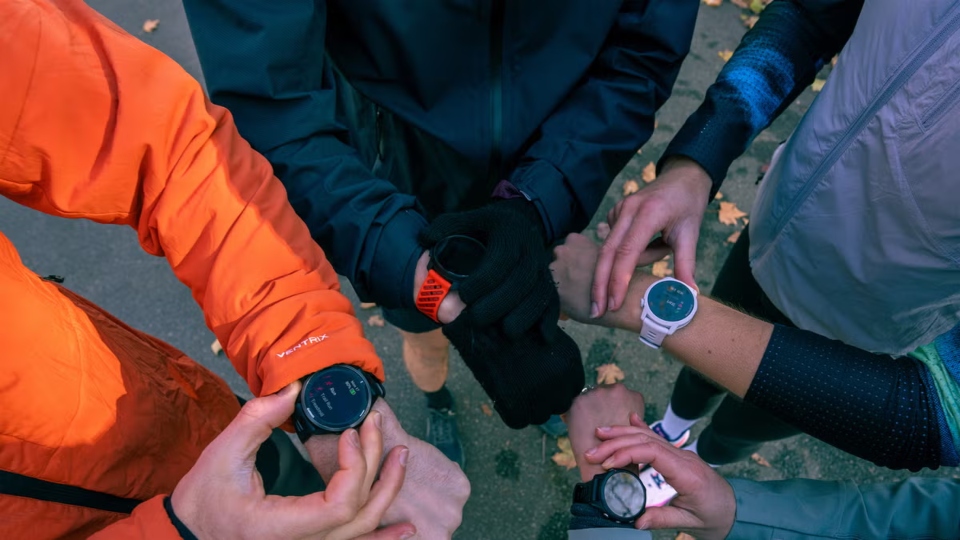
You finish your run and stop your watch.
Before you’ve even caught your breath, you’re checking the numbers.
Average pace. Moving time. Heart rate. Cadence. Elevation. Splits. Training load. Recovery time. VO2 max.
Then you hit upload on Strava.
Then you check everyone else’s runs.
Then, sometime later that evening, you find yourself wondering why your VO2 max has slipped by one point.
Congratulations. You didn’t go for a run. You went out collecting data.
For many of us runners, the watch on our wrists has become the key piece of equipment we bring with us to the track. Every run produces a mountain of statistics, and those numbers can tell us a huge amount about how we’re performing. They can motivate us, guide our training, and show us progress that we may otherwise miss.
But there comes a point when tracking your running can stop being useful and start becoming an obsession.
So, when does running data help you become a better runner – and when does it begin controlling how you feel about running? Join us at What We Running for all you need to know about data-obsessed runners.
What Is A Data-Obsessed Runner?
A data-obsessed runner is someone who depends heavily on statistics and technology to monitor, evaluate, and judge their running performance.
This may mean constantly checking pace, heart rate, cadence, elevation, mileage, training load, recovery scores, or VO2 max. For some runners, the numbers have become just as important as the actual run itself.
And there isn’t actually anything inherently wrong about that.
Running data can be extremely useful. It can help you see your progress, structure your training, identify patterns, set realistic goals, monitor recovery, and stay motivated. For example, if you’re training for a 5k, knowing your pace and mileage can help you work out whether your training is really heading toward your goal.
The problems arise when every run needs to produce a satisfying number.
A slow run suddenly feels like a failure. A lower-than-usual VO2 max becomes a crisis. A workout without a PB feels pointless.
This is where useful information can become an unhealthy fixation.
The Difference Between Tracking and Obsessing
The difference isn’t necessarily how much data you collect. It’s what you do with it.
| Healthy tracking | Data obsession |
| Uses data to understand running | Uses data to judge running |
| Looks for long-term trends | Worries about individual runs |
| Accepts bad numbers | Panics over bad numbers |
| Runs according to the plan | Changes plans because of the data |
| Enjoys the run itself | Thinks about the stats throughout |
A healthy relationship with running data means the numbers serve you. With data obsession, you can wind up serving the numbers.

10 Signs You’re A Data-Obsessed Runner
I’m not here to tell you there’s something wrong with liking a few numbers. Most of us do. But sometimes, you can tell things have gone a little too far.
If you’ve ever finished a run and spent more time analysing the findings than actually running them, some of these may just feel uncomfortably familiar.
1. You Check Your Watch Before You’ve Stopped Running
The run isn’t even finished, and you’re already clocking your final split.
You haven’t finished your cool-down. You’re barely breathing normally. But, somehow, you already know your average pace, distance, and whether that last kilometre was quicker than the one before.
For the data-obsessed runner, stopping the watch is almost part of the finish-line ritual.
And if the final number looks good? Fantastic.
If it doesn’t? Suddenly, you’re convinced the GPS was wrong.
2. A Bad Pace Can Ruin a Good Race
You actually enjoy the run.
The weather was good. Your legs felt strong. You found a good rhythm and spent half an hour loving life.
Then you looked at your average pace.
Apparently, it wasn’t quick enough.
It’s amazing how a perfectly good run can instantly become a disappointment when a number on your wrist doesn’t meet your expectations. The data hasn’t changed what happened during the run. It has simply changed how you feel about it.
3. You Know Your VO2 Max Better Than Your Blood Type
You’re probably not 100% sure of your blood type off the top of your head.
But ask you about your VO2 max, and you’ll have the answer in seconds.
For data-obsessed runners, metrics such as VO2 max can begin to feel like a direct measurement of fitness. A number going up feels like progress. A number going down feels like you’ve somehow lost fitness overnight.
The reality here is far more complex. Wearable devices estimate metrics such as VO2 max using various inputs, and they’re not a perfect representation of your overall running ability.
Still, try telling that to someone whose Garmin has just knocked two points off of their score.
4. You Run the Same Route to Beat Your Previous Time
I’m so guilty of this one.
At some point, your favourite running route stopped being a route and became more of a laboratory.
You know exactly where the first kilometre marker is. You know which corner gives you the best GPS reading. You know where you can pick up the pace, and precisely where you first start flagging.
And every time you run it, you’re comparing today’s performance with the previous one.
There’s absolutely nothing wrong with chasing PBs. But when every familiar route becomes another opportunity to show you’re getting faster, it can be tough to simply enjoy running through it.
5. You’ve Got Some Strong Opinions About GPS Accuracy
“There’s zero chance that mile was 0.97.”
“The GPS definitely cut the corner.”
“The tunnel messed up my pace.”
“The trees must have blocked the signal.”
Every data-obsessed runner has had conversations like these.
Sometimes the GPS genuinely is wrong. Running watches aren’t infallible, and satellite accuracy can vary depending on the environment.
But if you’ve ever spent five minutes reconstructing your route to demonstrate that your watch was responsible for an unimpressive split, you may have a problem.
6. You Refresh Strava After Uploading a Run
You tell yourself that you’re just checking that your activity uploaded properly.
Then you check it again.
And again.
Not because you especially care about the map or elevation profile.
You’re checking the kudos.
One appears. Brilliant.
Another appears. Great scenes.
Someone you haven’t spoken to since high school gives you a kudos. Unexpected, but definitely welcome.
Then you notice that your friend has run a 5k two minutes quicker than you; suddenly, your evening has been hit for six.
Strava is a great way of connecting with other runners. But, when people’s numbers begin affecting how you feel about your own efforts, it’s worth remembering that you’re looking at someone else’s highlight reel.
7. You Know Exactly How Much Elevation You Ran
You don’t just know you ran 7km.
You know that you climbed 156 metres.
And you know that last week’s run had 136 metres of elevation, meaning you’re somehow managing to increase your weekly elevation by 15 metres.
Why does this matter?
You don’t exactly know.
But it does matter.
For some runners, even the most obscure metric becomes something worth tracking. Elevation, cadence, ground contact time, vertical oscillation – eventually, your watch is collecting enough information to launch a small research project.
8. You Change Your Training Because Your Watch Told You To
This is the moment where being interested in running data can really start to become problematic.
Your watch says you’re not recovered, so you skip your planned session. Your training readiness scores look great, so you choose to push harder. Your suggested workout says you should run intervals, even though your legs feel like concrete.
Technology can be useful here, no doubt. Recovery scores, resting heart rate, sleep data, and suggested workouts can all provide handy information.
But that is all it is: information.
Your watch can’t tell everything you’re feeling. Sometimes your body is telling you something that your wrist isn’t.
The aim here should be to use technology to inform your training, rather than allowing it to make every choice for you.
9. You Can’t Enjoy an Untracked Run
This may just be the biggest warning sign of all.
You go for a run without your watch, and somehow it feels like it never happened at all.
There’s no distance to upload. No pace to analyse. No activity to share. No neat little graph showing what you achieved.
So, what was the point?
If you’ve gotten to the point where a run only feels worthwhile when it produces a set of statistics, you’ve probably lost sight of what running is meant to provide in the first place.
Some runs don’t have to be measured.
Some can just be enjoyed.
10. Your Running Is Better on Paper Than It Feels
Another one I’m guilty of.
You have the data.
Your mileage is going up. Your pace is improving. Your VO2 max is decent enough. Your training load looks good. You even scraped together some PBs.
On paper, you’re having a great time.
But you’re not really enjoying running anymore.
Every easy run feels too slow. Every hard run feels like a test. Every missed workout feels like failure. Every number is now something to judge yourself against.
And that’s perhaps the most obvious sign that you’ve become a data-obsessed runner.
The problem isn’t that you’re collecting too much information.
It’s that the information has begun to matter more than the experience.
Why Do Runners Become So Obsessed With Data?
So, why do we become so attached to numbers in the first place?
Part of the answer stems from how running can be frustratingly difficult to measure by feel alone. Data gives us something concrete to hold onto.
Data Makes Progress Valuable
Running doesn’t always result in obvious improvements. You may feel a smidge fitter without running noticeably faster, or spend weeks training without registering a single PB.
Numbers provide evidence that something is changing.
More mileage. A lower average heart rate. A faster 5k. A higher VO2 max.
Suddenly, all those tricky runs seem to have a purpose.
Running Gives Us Something We Can Control
There are plenty of things runners can’t control: genetics, weather, race-day conditions, illness, or just how our bodies feel on the day.
But you can control your mileage, pace, workouts, splits, and, at least to some extent, your heart rate.
When so much of running is unpredictable, those numbers can lend you a comforting sense of control.
Numbers Turn Running Into a Competition
Even though you’re supposedly only competing against yourself.
Your previous PB becomes the benchmark. Then your friend’s PB becomes the benchmark. Then a random runner you’ve never met on Strava becomes the benchmark.
Suddenly, your relaxing hobby has become a spreadsheet.
And once everything can be measured, everything can be compared.
Check Out Our Guide To Why Running Is So Addictive
Should You Stop Tracking Your Runs?
No. You don’t need to throw your running watch in the nearest hedge just yet.
Tracking your runs is incredibly useful. The trick is changing your relationship with the data rather than just scrapping things altogether.
Use Data to Notice Trends, Not Judge Individual Runs
One slow kilometre doesn’t tell you much about your fitness. Look at your running over weeks and months instead.
A bad run is just a bad run. It doesn’t wipe away all the good ones that came before it.
Separate Training Data From Self-Worth
A 25-minute 5k doesn’t make you more valuable than a 28-minute 5k.
Your pace is a measurement of your running performance, not a measurement of you.
Sometimes Leave the Watch at Home
Every now and then, try a data-free run.
Run according to your effort, breathing or simply how you feel that day. Pay attention to your surroundings. Enjoy the route. Stop worrying about whether you’re running the “right” pace.
You may be surprised by just how liberating it feels to complete a run without knowing exactly how fast you went.
How To Have A Healthier Relationship With Running Data
You don’t need to stop using your running watch or delete Strava. You just need to ensure the technology is working for you, rather than the other way around.
Choose Which Metrics Really Matter
You really don’t need 15 different statistics to understand your running.
For most runners, distance, time, and pace can tell you plenty. Heart rate and other metrics can be handy too, especially when you’re following a structured training plan, but more data isn’t necessarily better data.
Stop Checking Your Watch During Easy Runs
If it’s meant to be an easy run, let it be easy.
Run by feel. Pay attention to your breathing and how your legs feel rather than constantly trying to keep your pace within a particular range.
Review Your Data Once, Then Move On
There’s nothing wrong with analysing a run.
Just don’t sink 45 minutes analysing a 30-minute session.
Take what you need from the numbers, learn anything useful and then proceed with your day.
Compare Yourself With Your Past Self
Your biggest competition doesn’t need to be the fastest person on Strava.
Look at your own progress instead. Are you running further? Feeling stronger? Recovering better? Enjoying it more?
These improvements matter too.
Have Some Runs That Don’t Need to “Count”
Not every run needs to contribute to a PB.
Some runs are allowed to just be runs.
No target pace. No performance goal. No meaningful statistic waiting at the finish line.
Just you, your shoes, and somewhere to run.
Wrap Up
You don’t need to chuck your Garmin away.
You don’t have to delete Strava.
And you certainly don’t need to stop chasing PBs if that’s what makes running motivating for you.
The numbers can be useful. They can motivate you, guide your training, and show you that progress isn’t always immediately obvious from day to day.
But they shouldn’t become the reason you run.
Every now and then, leave the watch at home. Go somewhere you’ve never run before. Forget about your pace. Stop worrying about whether your heart rate is in the right place.
Just run.
Because sometimes your best run isn’t your fastest one.
It’s the one where you forget to check your pace entirely.
Check Out Our Guide On How To Stay Motivated To Run

Loves Parkrun. Hates running uphill. After investing in his first pair of proper running shoes, James was inspired to found What We Running in 2026 with the aim of sharing his favourite tips, tricks, and motivational hacks needed to sustain a running journey.